
House Brunner-Bapst
Waltensburg, Switzerland

Project Data
IPV System Data
Information and data provided by: Eurac Research
Introduction
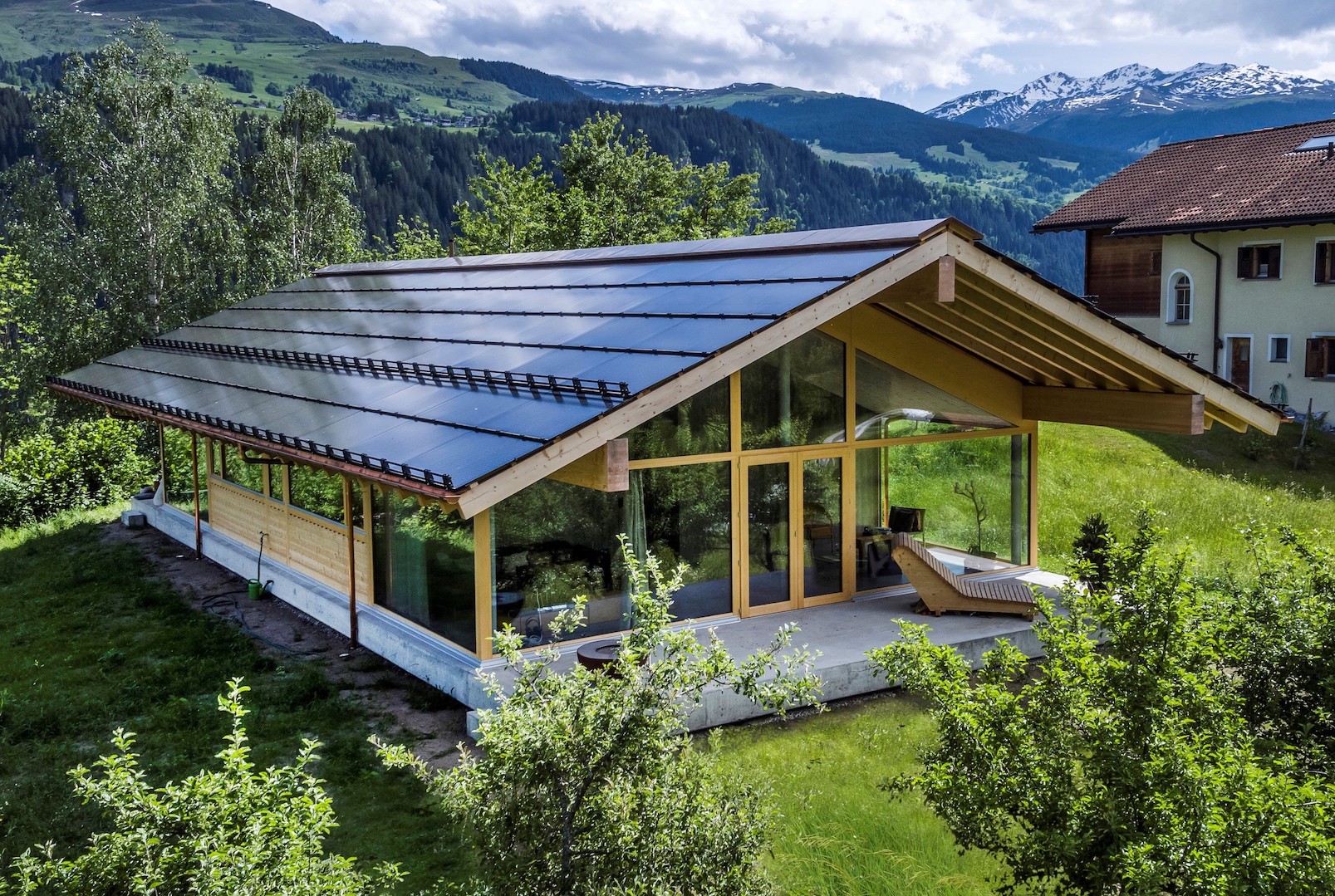
In 2020, the Brunner-Bapst farming family built a PlusEnergie single-family house in Waltensburg with the highest solar energy supply ever installed in Switzerland up to that point. The BIPV system covers the entire roof of the building.
Sources: Norman Foster Foundation, Solargentur.CH
Project approach
With large glass and wood façades and a simple design, the new building blends into the surrounding landscape. The BIPV system is part of modern building design based on energy efficiency and the use of renewable energy. The project won the Norman Foster Solar Award in 2020.
Aesthetic integration
BIPV modules are arranged in a regular and coplanar manner on both roof pitches and do not require inactive elements to fully cover the surfaces. They give the roof a dark and uniform appearance. Elements of a different colour from the modules were inserted to connect the two pitches along the roof ridgeline.
Technology integration
The BIPV modules completely cover both the east and west pitches of a large roof that produces energy and extends far beyond the building, protecting it from wind and weather. They replace the traditional roof elements.
Energy integration
The BIPV system produces 40,200 kWh per year, covering 817 % of the building’s electrical consumption, a Swiss and European PEB record. Due to the 20 to 30 cm thick insulation of the walls and roof, class A++ appliances, and LED lighting installation, the electrical demand is relatively low and equals approximately 4,915 kWh per year. The surplus of approximately 35,239 kWh is partly used for charging electric cars using charging stations connected to the system. The remainder is sent to the network.
Lessons learnt
It is estimated that the energy produced prevents the emission of almost 2.6 tonnes of CO2 in the atmosphere.


Architectural Elements involved


Stakeholders involved
